
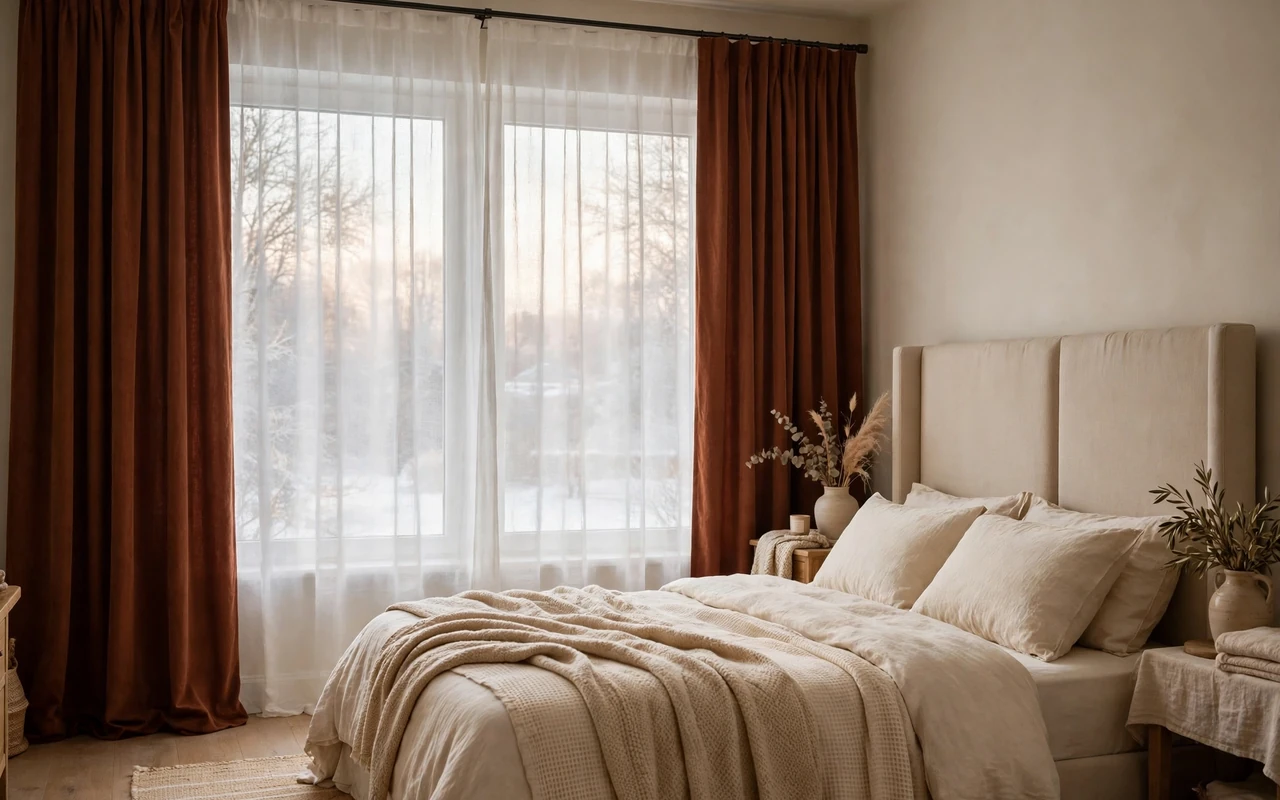
Most bedroom curtain advice stops at picking a color. The curtain that actually warms a room does three jobs at once: it softens the light, it covers the cold glass, and it makes the wall look taller than it is. A thin panel hung too low does none of those, however pretty the fabric is.
Every idea below is built for a real bedroom in December: heavy fabrics and thermal linings for cold mornings, sheers for gray daylight, and a Budget, Time and Renter-friendly line on each one so you can tell before you buy whether it fits your room and your lease. Start with the window you sleep nearest to, then work around the room.
Quick answer: how do curtains warm up a bedroom? Hang full-length panels on a rod 4 to 6 inches above the window frame and 8 to 12 inches wider than the frame on each side, choose a heavier fabric or a thermal lining for winter, and layer a sheer behind a blackout or velvet panel so you get soft daylight by day and real darkness at night.
1. Hang sheer voile panels for soft daylight
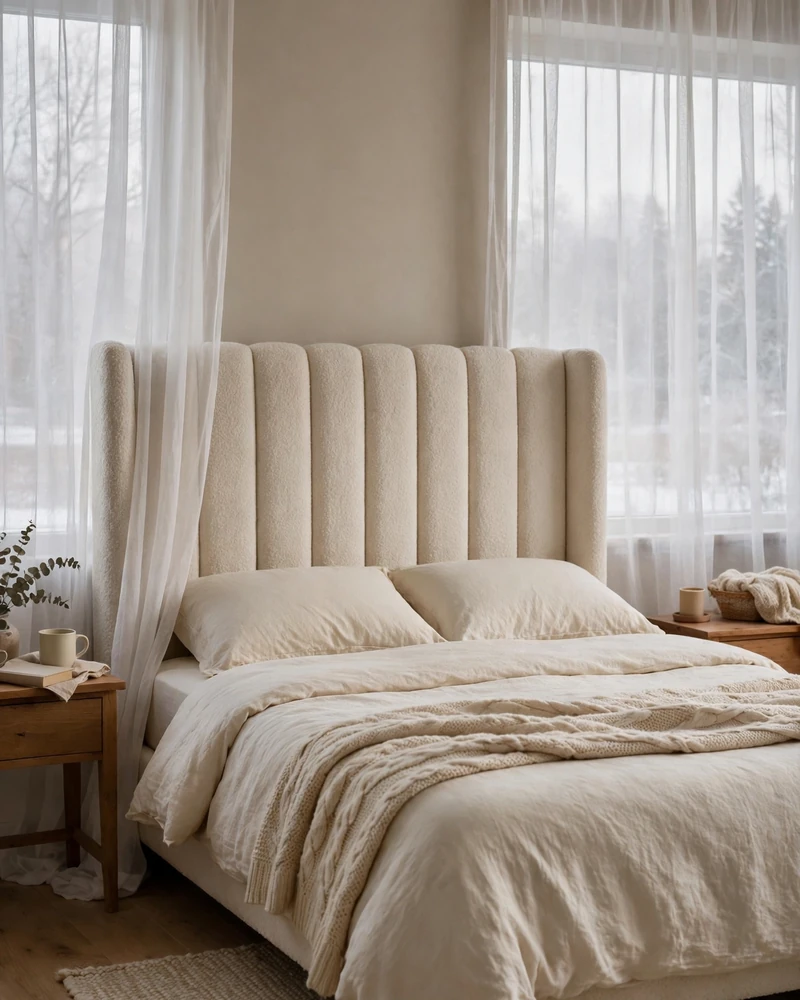
Sheer voile panels are thin, see-through curtains that soften daylight without shutting it out.
Hang a pair of voile panels on a slim rod so they cover the whole window and just touch the floor. White or cream voile works in almost any bedroom; a pale gray voile suits a room with cool bedding. The fabric lets light through while blurring the view from outside, so the room stays bright on a gray December morning without feeling exposed.
Sheers suit a small bedroom because they add almost no visual weight.
Sheers give partial privacy by day only. After dark, anyone outside can see a lit room through them, so pair them with a blind or a heavier panel if the window faces a street.
Budget: $15–$40 per pair. Time: 15 minutes. Renter-friendly: yes.
2. Hang blackout panels for real darkness
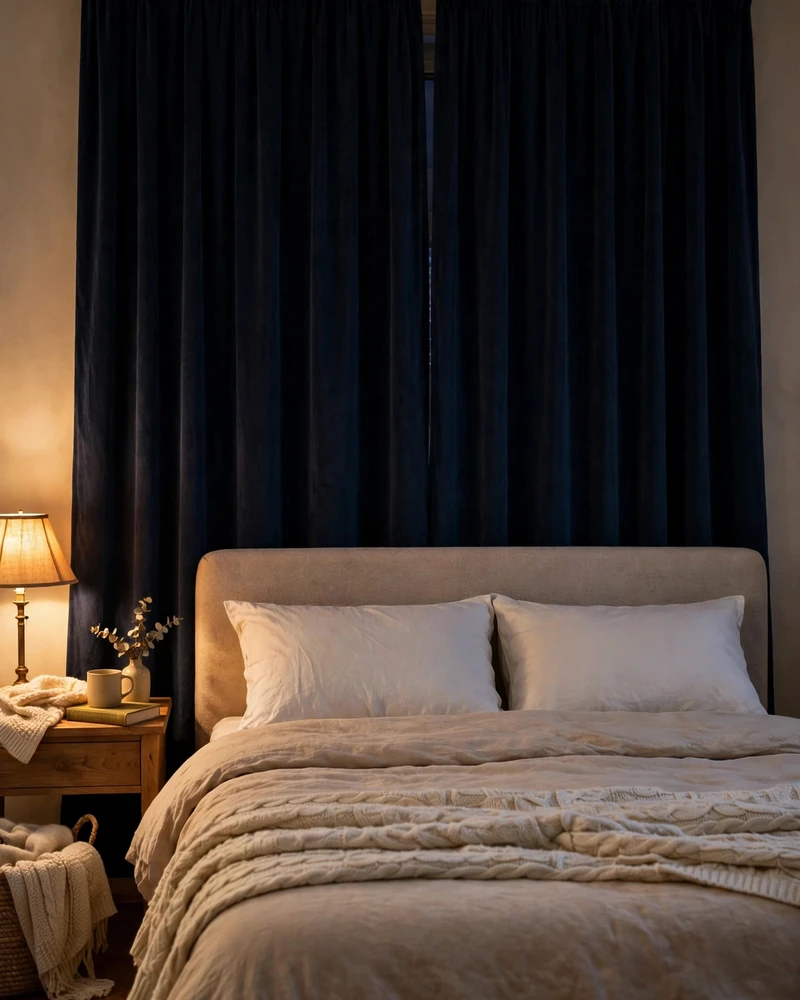
Blackout panels are curtains with a dense lining that blocks outside light from entering the room.
Hang them on the same high, wide rod position, with panels wide enough to overlap in the middle and cover the frame edges when closed. Deep navy, charcoal or forest green reads as a color choice in daylight and as darkness at night. Close them fully at bedtime and open them wide in the morning so the room never feels shut in during the day.
They help light sleepers, shift workers and anyone whose bedroom faces a streetlight, and they add a layer of insulation over cold glass in winter.
Blackout fabric is heavy, so use a sturdy rod with brackets screwed into the wall or a strong tension rod rated for the weight. A flimsy rod will bow in the middle within weeks.
Budget: $25–$70 per pair. Time: 20 minutes. Renter-friendly: yes, if the rod is already up.
3. Choose light-filtering linen panels
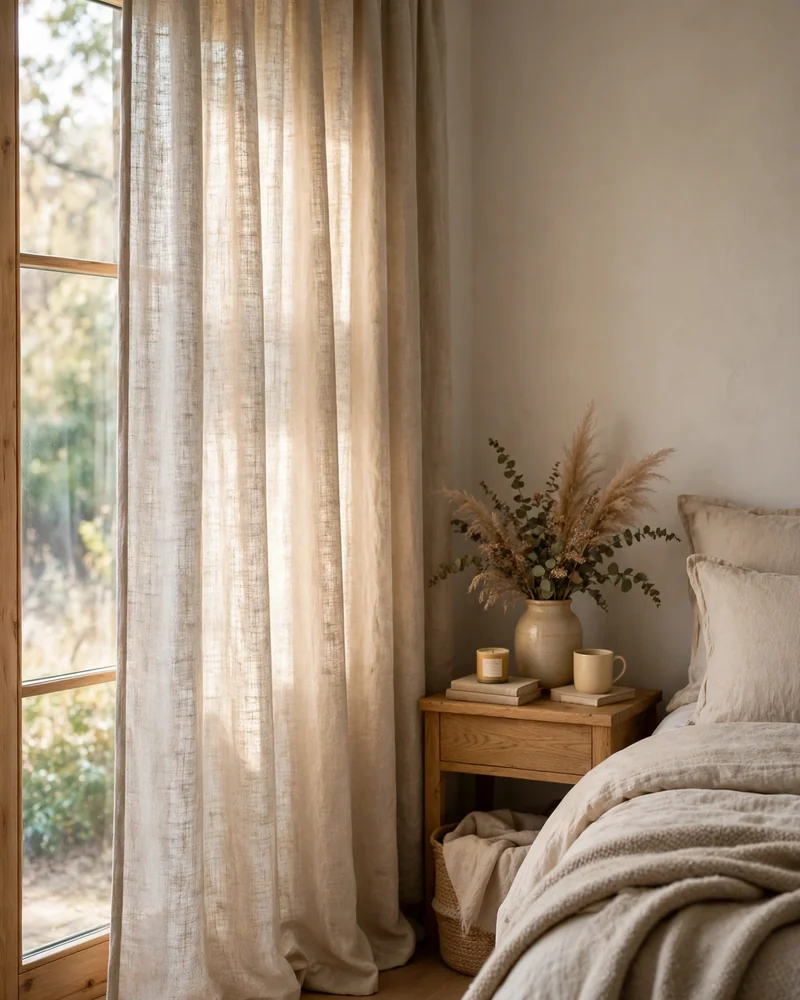
Light-filtering linen panels are woven loosely enough to glow in daylight and tightly enough to give the room a finished, private feel.
Hang them so they fall straight from the rod to the floor with no puddling. Natural oatmeal, stone or soft white linen suits a relaxed bedroom; washed linen hides creases better than crisp cotton. Two panels per window look fuller than one wide panel pulled to a single side.
Linen breathes, so the room never feels sealed, and the texture reads as warm even in a pale color. It is the middle ground between a sheer and a blackout: brighter than a drape, more private than voile.
Linen shrinks if washed hot, so check the care label before buying and wash on cold if the panels are machine washable. Hang them back up slightly damp so they dry straight.
Budget: $30–$80 per pair. Time: 20 minutes. Renter-friendly: yes.
4. Layer sheer and blackout on a double rod
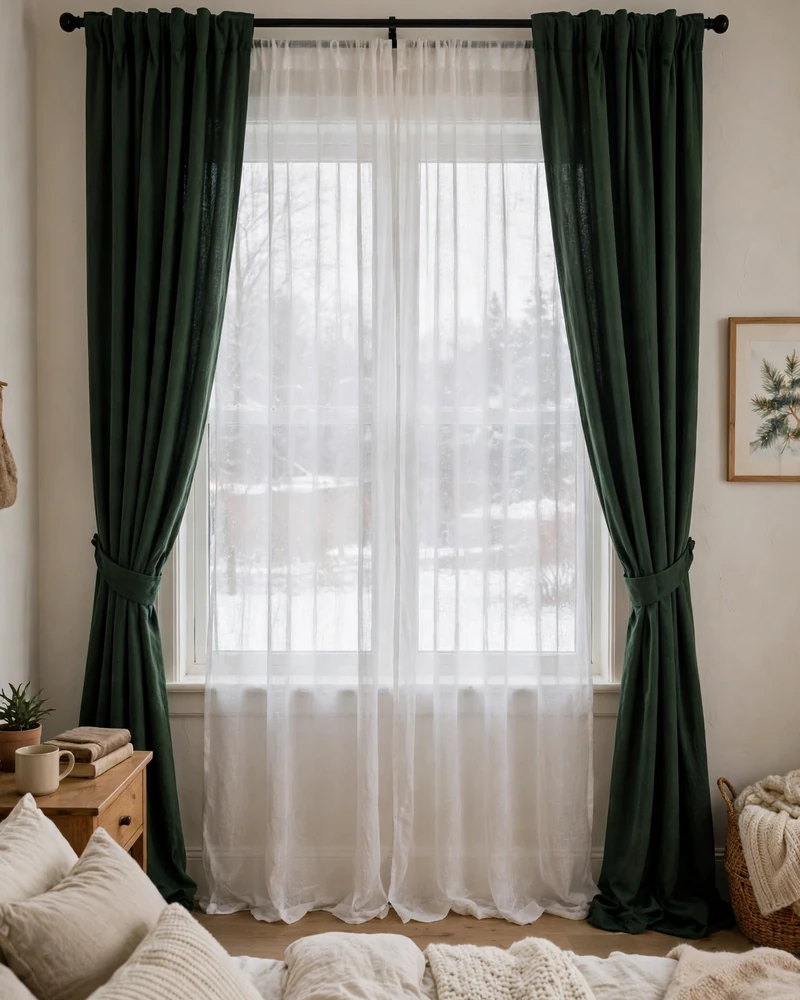
A double rod holds two curtain layers on one window: a sheer on the back rod and a heavier blackout panel on the front rod.
Fit the double brackets, hang the sheer closest to the glass and the blackout in front, and keep both layers full length. By day, draw the blackout panels to the sides and leave the sheer closed for soft light. At night, close the blackout layer for darkness and privacy.
This is the most flexible setup in the list because one window does two jobs without a blind. It also looks layered and deliberate, which a single flat panel rarely does.
The double rod needs brackets that clear the wall by a few inches so the two layers never catch on each other. Measure the bracket depth before ordering.
Budget: $40–$100 for rod and panels. Time: 30 minutes. Renter-friendly: yes, if the rod is already up.
5. Pair curtains with blinds or Roman shades
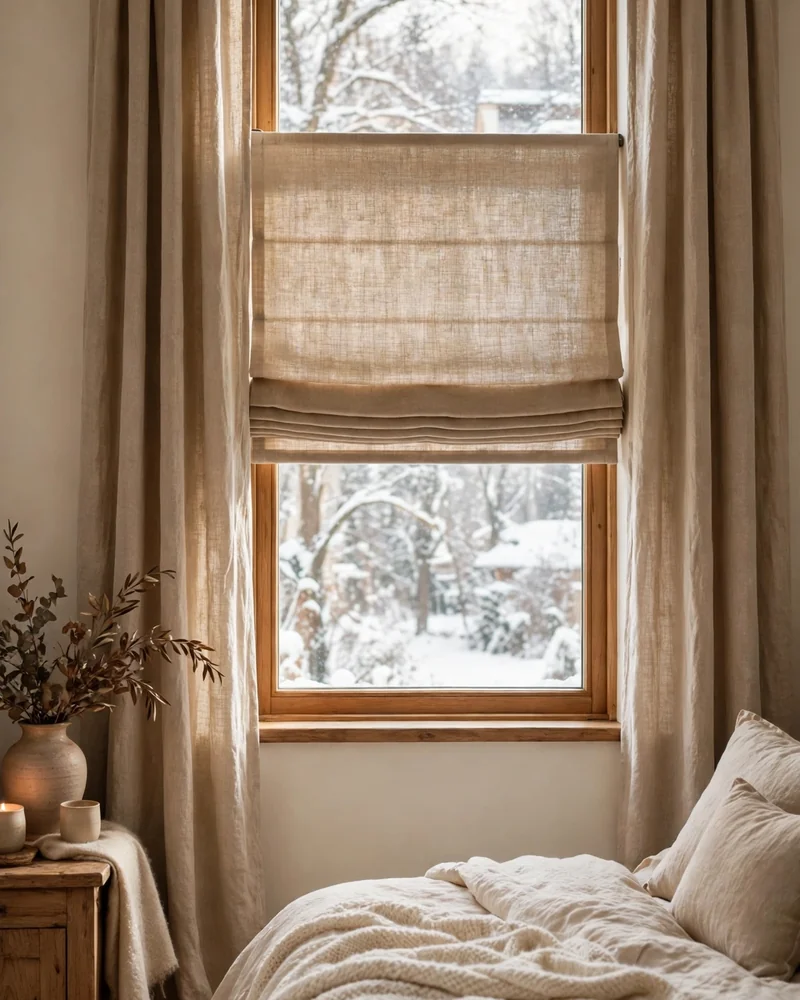
Curtains paired with a blind or a Roman shade give the window a hard layer for privacy and a soft layer for warmth.
Mount the blind or shade inside the window frame and hang the curtains on a rod outside it, so the two never fight for the same space. Lower the shade at night for privacy, then draw the curtains closed over it for insulation. By day, raise the shade and open the curtains for full light.
It also lets you use a lighter curtain fabric because the shade carries the privacy job.
Fit the shade first and the curtains second. A shade measured to the inside of the frame is easy to get wrong, so measure the width in three places and use the smallest number.
Budget: $50–$120 for shade and panels. Time: 30 minutes. Renter-friendly: yes, with a tension-fit shade.
6. Hang velvet drapes for warmth and sound
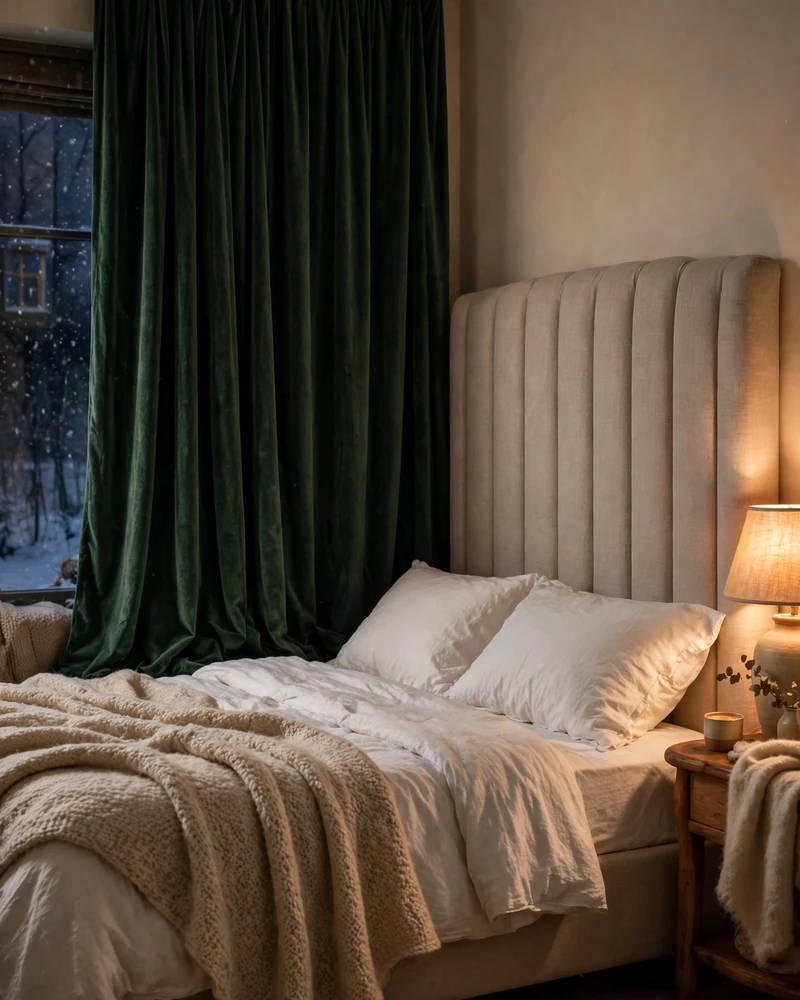
Velvet drapes are heavy curtains with a dense pile that holds warmth in and softens sound in a hard-floored room.
Hang them full length on a sturdy rod, with panels wide enough to cover the frame plus a few inches on each side when closed. Deep green, navy, rust or burgundy suits a winter bedroom; a lighter velvet in blush or sage works if the room is already dark. Keep the panels brushed in one direction so the color reads evenly.
Velvet insulates better than cotton or linen because the pile traps air, and it muffles echo from bare floors and plain walls. It makes a cold, echoing bedroom feel settled.
Velvet gathers dust and usually needs dry cleaning, so vacuum it with a brush head once a month and keep it away from a radiator, where heat can flatten the pile.
Budget: $50–$120 per pair. Time: 20 minutes. Renter-friendly: yes, if the rod is already up.
7. Use thermal-lined curtains for winter drafts

Thermal-lined curtains are ordinary-looking drapes with a thick insulating lining sewn behind the face fabric.
Hang them the same way as any full-length panel, but make sure the lining sits flat against the glass with no gap at the sides. A neutral face fabric in cream, gray or oatmeal keeps the room light, while the lining does the insulating work unseen. Close them at dusk, when the glass is coldest, and open them on a sunny morning.
They cut the cold draft that slides off a window at night, which is the draft most people feel in bed.
Thermal linings add weight, so check the rod brackets before hanging and use a center support on a wide window. A sagging rod leaves a gap at the top where cold air pours in.
Budget: $40–$100 per pair. Time: 20 minutes. Renter-friendly: yes, if the rod is already up.
8. Match the curtains to the wall color
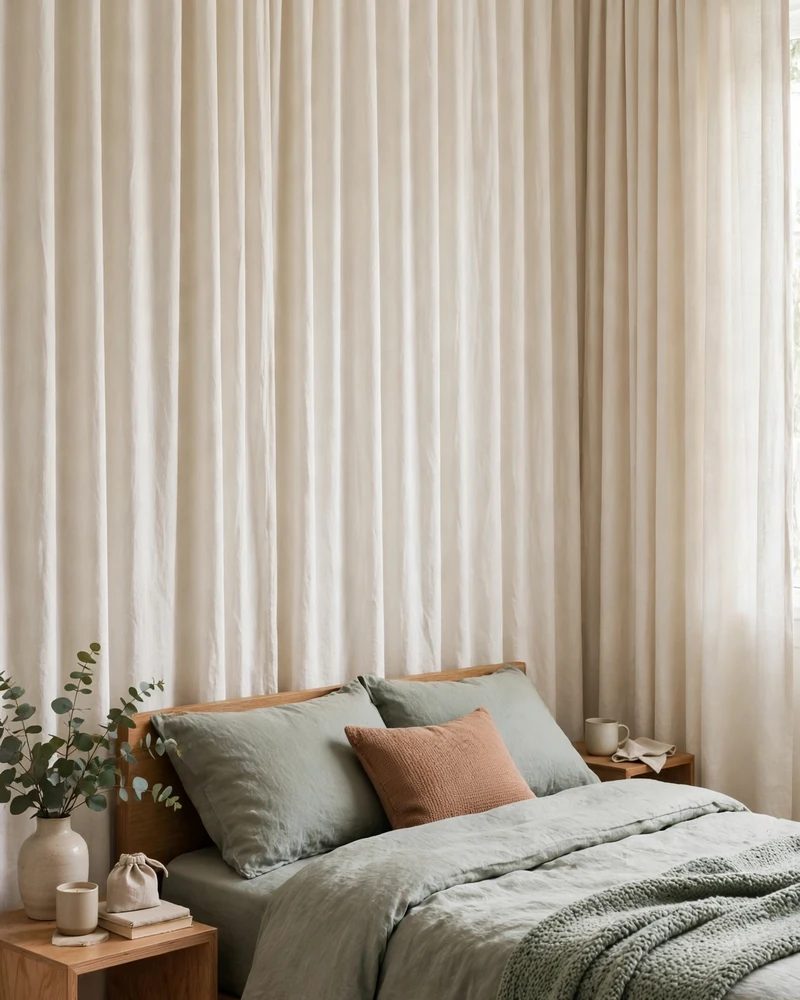
Tone-on-tone curtains are panels in the same color family as the walls, a shade lighter or darker, so the window wall reads as one surface.
Pick a fabric one shade deeper than the wall paint and hang it full length on a rod mounted high and wide. Warm white curtains on warm white walls, or pale gray on gray, stretch the wall visually because the eye finds no hard edge between curtain and plaster. Keep the bedding a different tone so the bed still stands out.
This is the strongest small-room idea in the list. A bold curtain color chops a small wall into bands, while a tone-on-tone panel lets the whole wall read as one tall surface.
Take a paint chip or a cushion to the shop when choosing the fabric.
Budget: $25–$70 per pair. Time: 20 minutes. Renter-friendly: yes.
9. Make one bold color the room’s statement
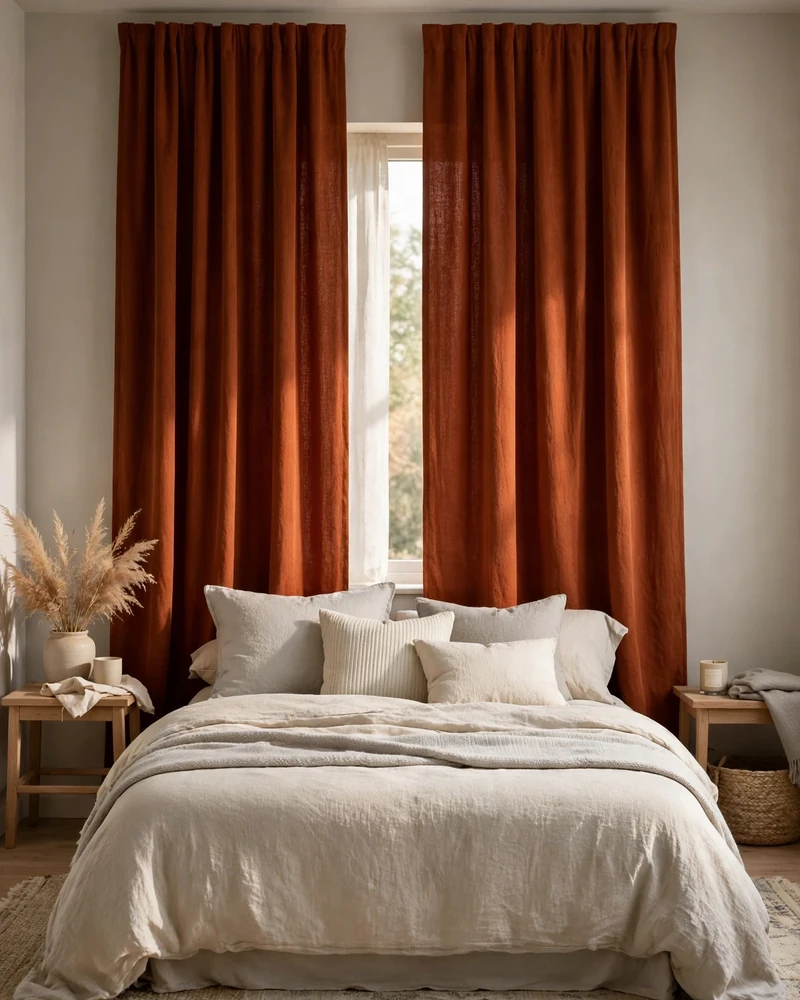
One bold curtain color is a single strong color on the window wall while everything else in the room stays neutral.
Choose emerald, navy, rust or deep burgundy and hang the panels full length, with bedding, rug and cushions in cream, gray or oatmeal. The curtain becomes the room’s color, so nothing else needs to compete with it. A solid color reads as bolder and cleaner than a bold pattern at the same size.
It works because a bedroom only needs one color decision to feel designed. The curtain is the largest single piece of color in most bedrooms, so choosing it deliberately saves you from scattering small colored objects around the room.
Buy the panels from one batch so both panels match exactly. Two panels dyed in different batches can read as two different colors in daylight.
Budget: $25–$80 per pair. Time: 20 minutes. Renter-friendly: yes.
10. Choose a patterned curtain
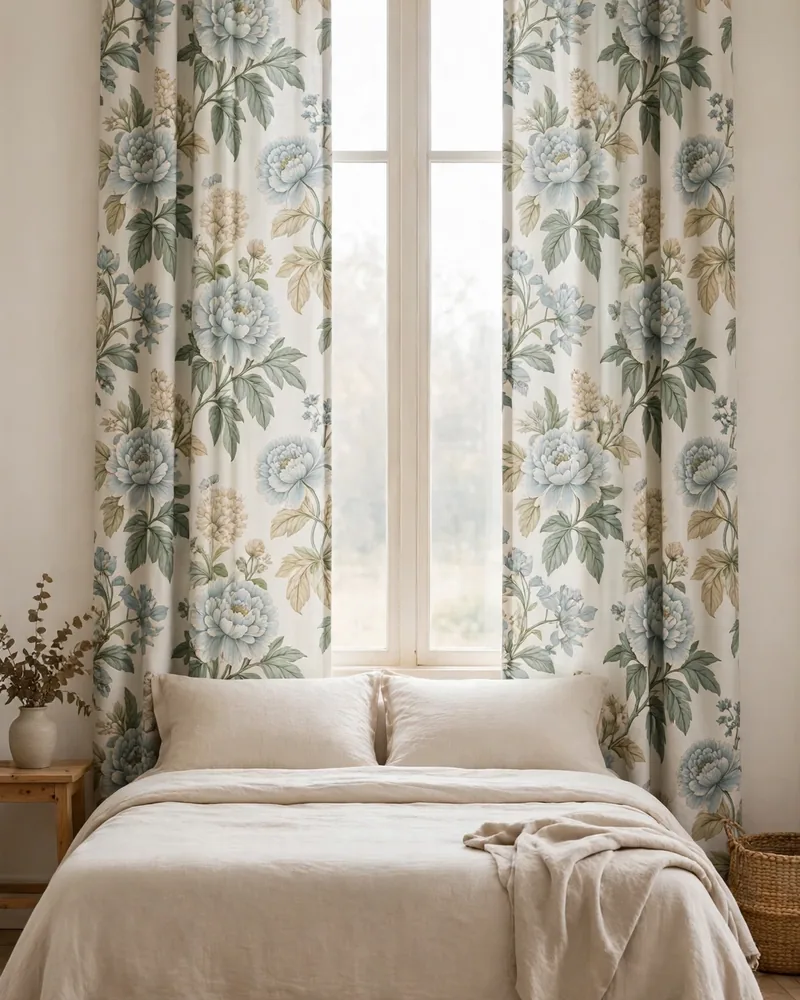
Patterned curtains carry a print — florals, geometrics or stripes — while the walls and bedding stay plain.
Pick one pattern and keep the rest of the room quiet: plain bedding, a plain rug, solid cushions. A large-scale floral suits a calm bedroom if the background is pale; a geometric in two colors suits a modern room; vertical stripes make a low window look taller. Hang the panels so the pattern runs straight and the repeats line up across the two panels.
A pattern gives the window wall a focal point without any extra decoration, and it hides creases and dust better than a flat solid color. It also makes a plain rented room feel finished in one move.
Match the pattern repeat at the top of both panels before hanging. A half-repeat offset between the two panels is visible from the doorway.
Budget: $30–$90 per pair. Time: 20 minutes. Renter-friendly: yes.
11. Hang floor-to-ceiling panels on a high rod
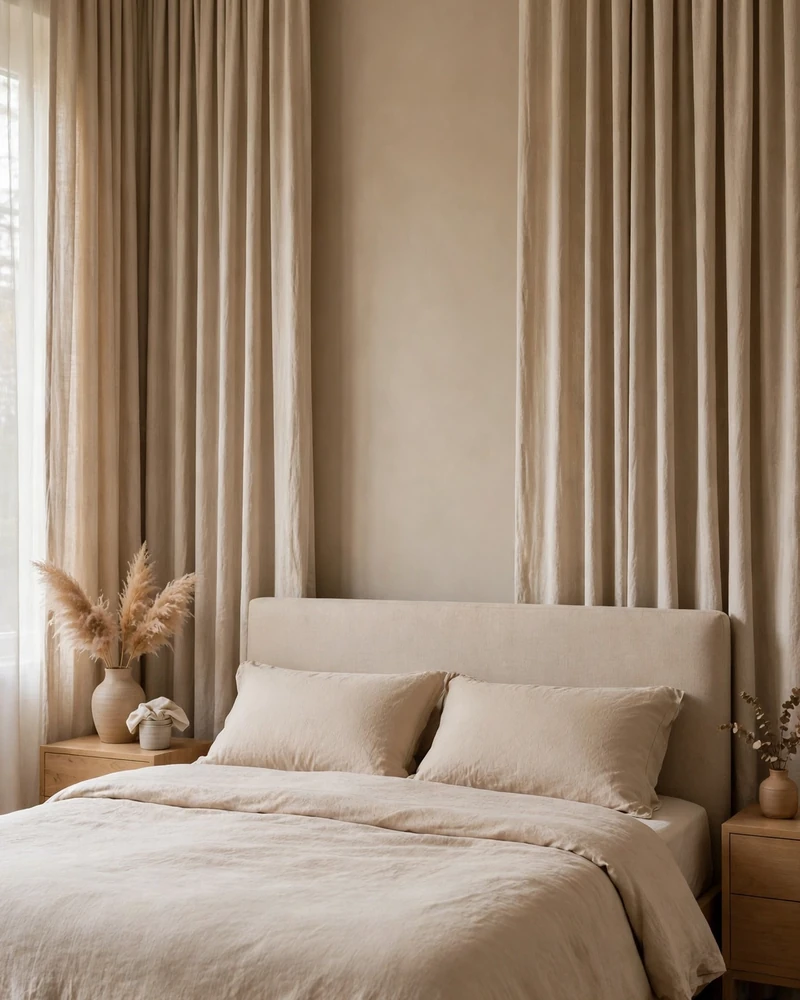
Floor-to-ceiling panels are curtains that run from a rod near the ceiling all the way to the floor, covering the whole window wall.
Mount the rod 4 to 6 inches below the ceiling, or as high as the wall allows, and choose panels long enough to just touch the floor. Standard lengths run 84, 96 and 108 inches, so measure from the rod to the floor before ordering. The long drop makes the ceiling look higher and the window look bigger, even in a room with a small window.
Panels that stop a few inches short of the floor look unfinished and show a strip of bare wall. Measure twice, because a panel that is too short cannot be fixed by pulling it down.
Budget: $35–$100 per pair. Time: 30 minutes. Renter-friendly: yes, with a rod already mounted high.
12. Hang the rod high and wide
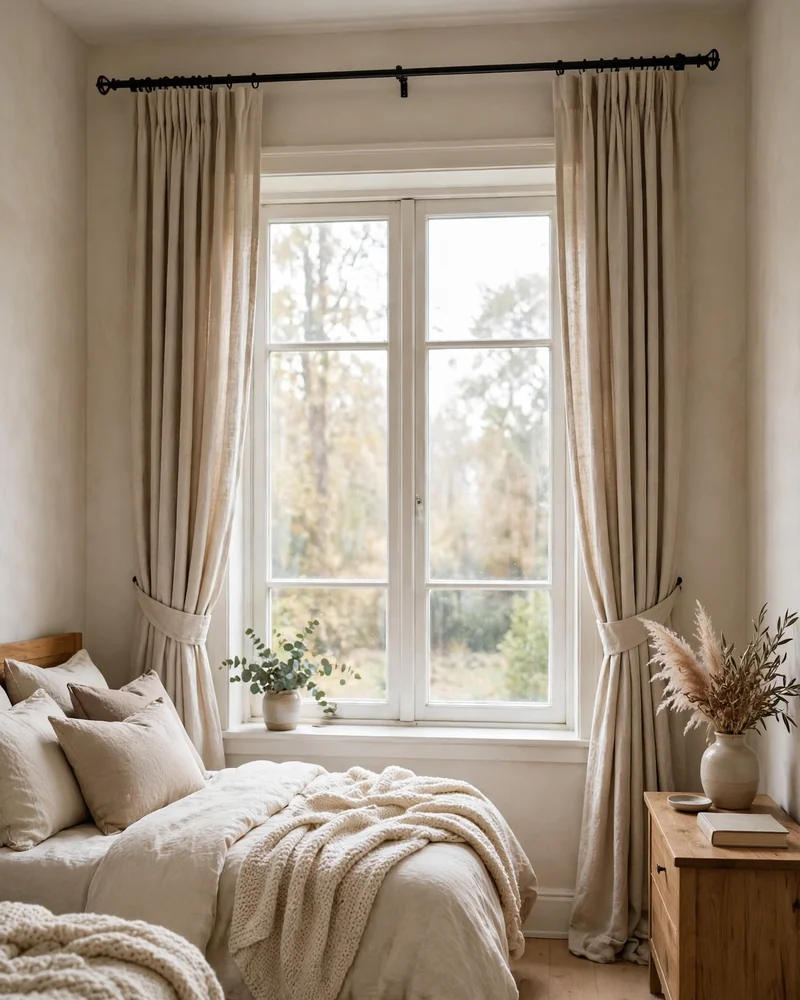
Hanging the rod high and wide is a measuring rule that applies to every curtain style: the rod sits above the window frame and extends past it on both sides.
Mount the rod 4 to 6 inches above the frame and 8 to 12 inches wider than the frame on each side, then hang panels that cover the frame edges when closed and stack clear of the glass when open.
It costs nothing beyond the rod itself, and it fixes the two most common curtain mistakes in one move: a rod hung on the frame, and panels too narrow to cover it.
Hold the rod up and mark the bracket positions with the panels on it before drilling, so the stacked panels clear the glass. A rod measured without the panels often ends up too short.
Budget: $15–$40 for the rod. Time: 30 minutes. Renter-friendly: yes, with no-drill brackets or a tension rod.
13. Choose pinch-pleat drapes for a tailored look
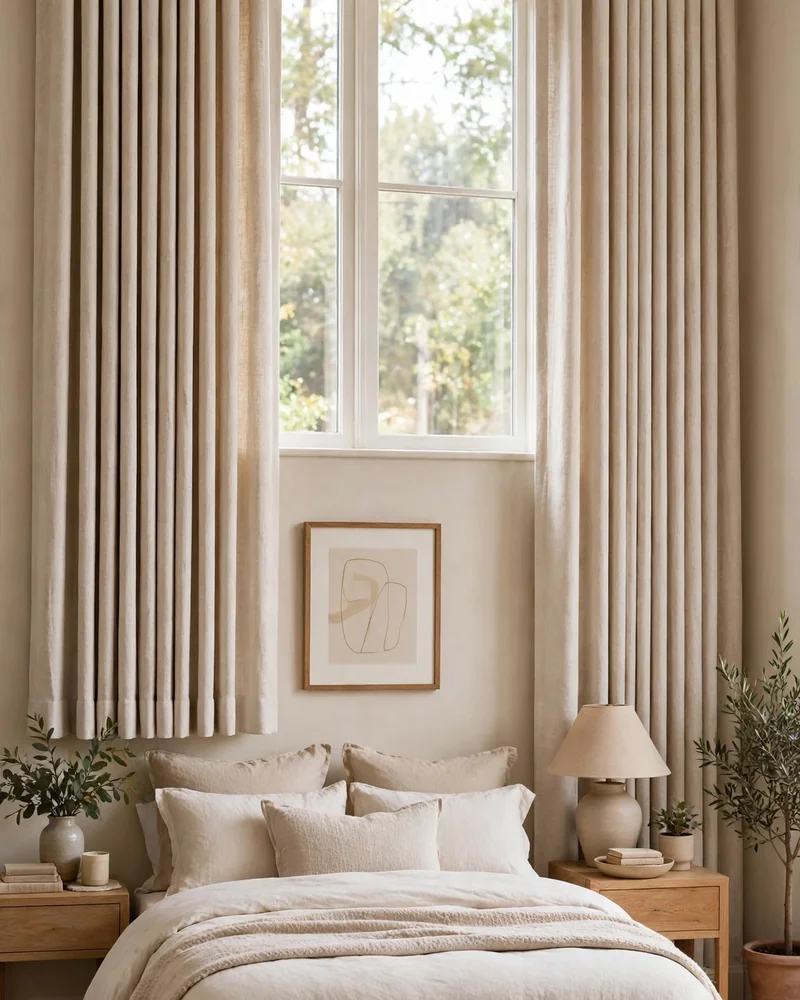
Pinch-pleat drapes are curtains sewn into neat, evenly spaced folds at the top, so they hang in straight vertical lines.
Hang them on a rod with rings or a track using drapery hooks in the pleats, and let the folds fall without tying them back. The pleats hold their shape, so the curtain looks pressed even after weeks of use. A solid color in linen, cotton or velvet suits the tailored style; a busy pattern fights the clean lines.
They also stack neatly to the sides, which keeps the glass clear by day.
Pinch pleats need the right fullness, about two times the window width in fabric, or the folds pull flat. Check the fullness on the packet before buying.
Budget: $40–$110 per pair. Time: 20 minutes. Renter-friendly: yes, if the rod is already up.
14. Use eyelet panels for easy everyday use

Eyelet panels are curtains with large metal rings punched along the top edge, so they slide straight onto the rod.
Thread the rod through the rings and let the fabric fall in soft, even waves. Matte black, nickel or bronze rings suit a modern bedroom; the rings themselves become part of the look, so choose a finish that matches the rod and the room’s other metal.
They suit a bedroom where the curtains move every day, such as a room that needs darkness at night and full light in the morning. The rings also keep the top edge neat without pleats or hooks to adjust.
Eyelet panels need a rod with removable finials, since the rings slide on from the end. A fixed finial means the rod has to come down before the panels go on.
Budget: $20–$60 per pair. Time: 10 minutes. Renter-friendly: yes.
15. Add tiebacks and holdbacks
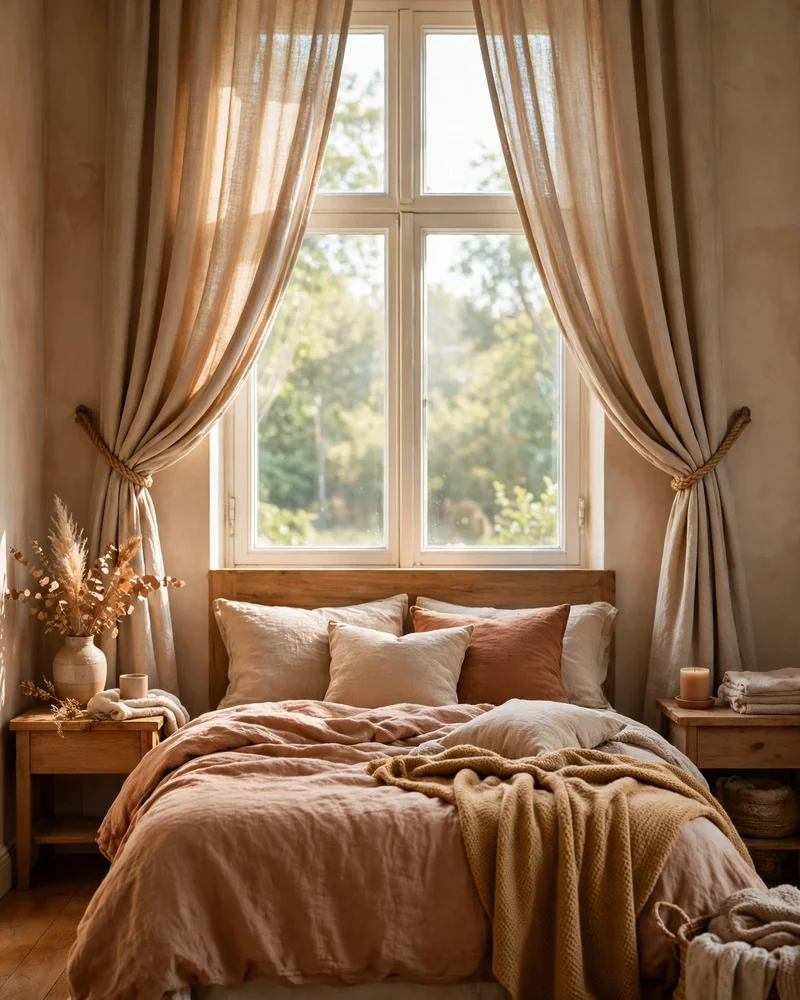
Tiebacks and holdbacks are the cords, straps or metal hooks that hold a curtain panel to the side of the window.
Fix a holdback to the wall about two-thirds of the way down the panel, or loop a rope or leather tieback around the gathered fabric at the same height. The panel falls in a curve instead of hanging straight, which shows the window and the daylight while keeping the curtain dressed. Rope suits a relaxed room, leather suits a modern one, and a slim metal holdback suits a tailored drape.
They turn a closed-looking window into an open one without moving the rod, and they keep a long panel off the floor where it would otherwise be stepped on.
Tie the panel at the same height on both sides. One tieback higher than the other is the first thing anyone notices from the doorway.
Budget: $10–$30 per pair. Time: 15 minutes. Renter-friendly: yes, with adhesive or no-drill holdbacks.
16. Hang curtains behind the bed as a soft headboard
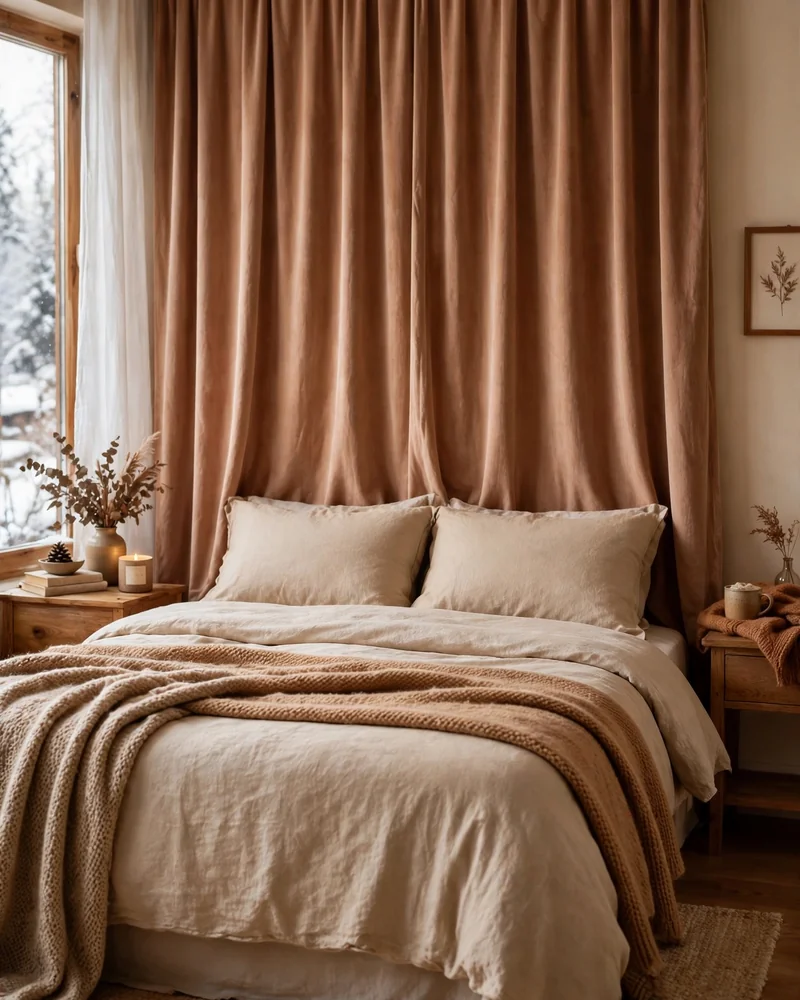
Curtains behind the bed are full-length panels hung on the wall behind the headboard, so the fabric acts as a soft headboard.
Mount a rod the width of the bed, or slightly wider, about 6 inches above the headboard height, and hang panels that reach the floor behind the bed. A velvet or heavy linen in a warm tone suits the job; a sheer is too thin to read as a headboard. The fabric softens the wall, hides a plain or damaged wall, and frames the bed the way a wooden headboard would.
Keep the panels clear of the pillows so the fabric never brushes your face at night, and use a rod that holds the panels flat to the wall rather than bowing out over the bed.
Budget: $30–$80 for rod and panels. Time: 30 minutes. Renter-friendly: yes, with no-drill brackets.
17. Set up a no-drill curtain system for renters
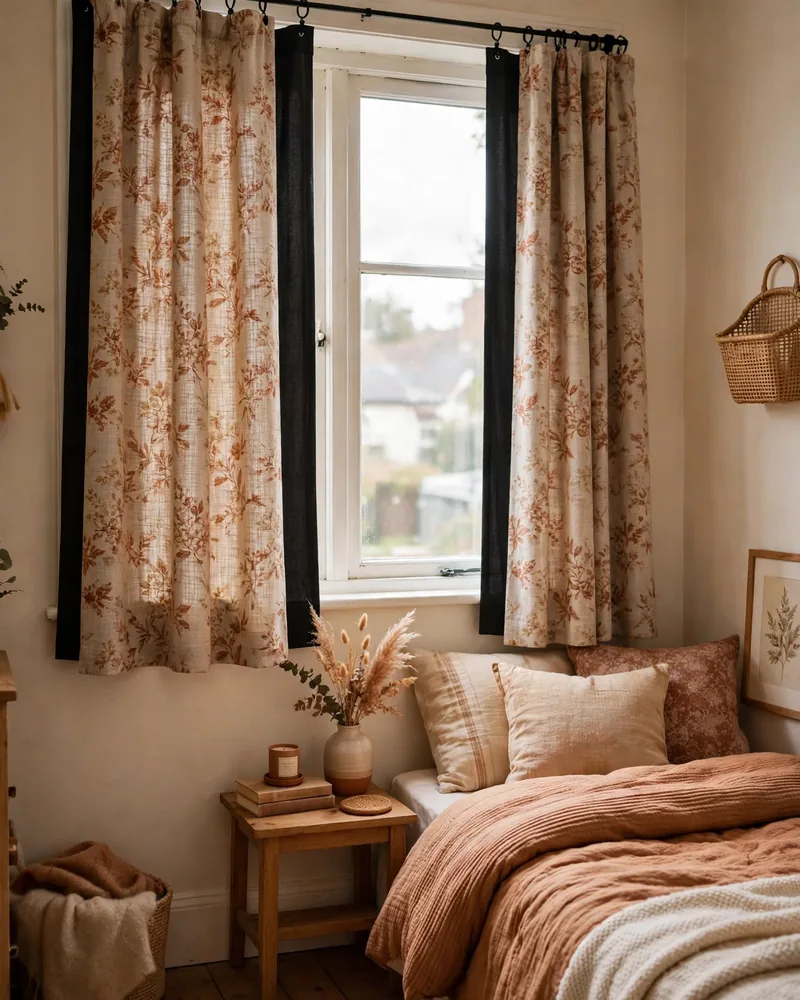
A no-drill curtain setup is a renter’s way to hang full curtains without putting holes in the wall.
Use a tension rod inside the window frame, adhesive hooks rated for the panel weight, or clip rings on a tension rod, and add a blackout liner behind a pretty face fabric if the room needs darkness. Café curtains on a tension rod cover the lower half of a ground-floor window for privacy while leaving the top open for light. Everything comes down in minutes and leaves no mark.
Check the weight rating on the hooks and the tension rod before hanging heavy fabric. A blackout panel on an unrated hook will slide down overnight, usually at 3 a.m.
Budget: $20–$60 for rod, hooks and liner. Time: 20 minutes. Renter-friendly: yes.
What to skip
- Panels that stop at the windowsill. Short curtains make the window look smaller and leave the wall below it bare. Go full length, or use a café curtain deliberately for privacy.
- One narrow panel on a wide window. A panel that cannot cover the frame when closed leaks light at the edges and looks stretched. Two panels, each about the width of the window, is the usual fix.
- A rod mounted on the window frame. It shrinks the window, blocks light when the panels are open, and makes the room look lower. Mount it high and wide instead.
- Matching the curtains to the bedding exactly. Curtains that match the duvet look like a set from a catalog. Let them complement the bedding instead, in a different tone of the same color family.
Start with the measuring rule in idea 12, even if you buy nothing else this week. A rod hung 4 to 6 inches above the frame and 8 to 12 inches wider than it makes almost any panel look better, including the ones already hanging in your room. Then pick one fabric job the room actually needs: darkness, warmth, soft light or privacy. Buy that one first, hang it full length, and live with it for a week before adding a second layer.
In January, the heavy winter layers can come down and the sheers can stay. The rod, the measurements and the hanging height stay the same all year, which is why they are worth getting right in December.